
Discovery is not a solved problem at most large enterprises. Privileged account inventories are incomplete, drift between audit cycles, and miss accounts that appear between scans. Continuous, real-time discovery is still an active engineering problem for most identity programs, and closing that coverage gap remains foundational work.
But closing the coverage gap surfaces a second problem immediately. When an account is collected by standard discovery processes, the you are collecting the stateful data: group memberships, password age, vault status, etc. What it cannot give you is behavioral context: what kind of principal is behind this account, how it authenticates, how frequently, and whether its entitlements are changing.
For human accounts, that context is often derivable from organizational data. There is a manager, a role, a business function. Access reviews have a path.
For non-human accounts, stateful data alone does not provide enough to conduct a meaningful review. An unmanaged account could be a legacy service account predating the current PAM program, a vendor API integration, or an autonomous workflow with no formal owner. Each has a different appropriate access posture and routes to a different remediation target. Without behavioral classification, those distinctions are not visible in the review queue.
What Behavioral Signals Provide
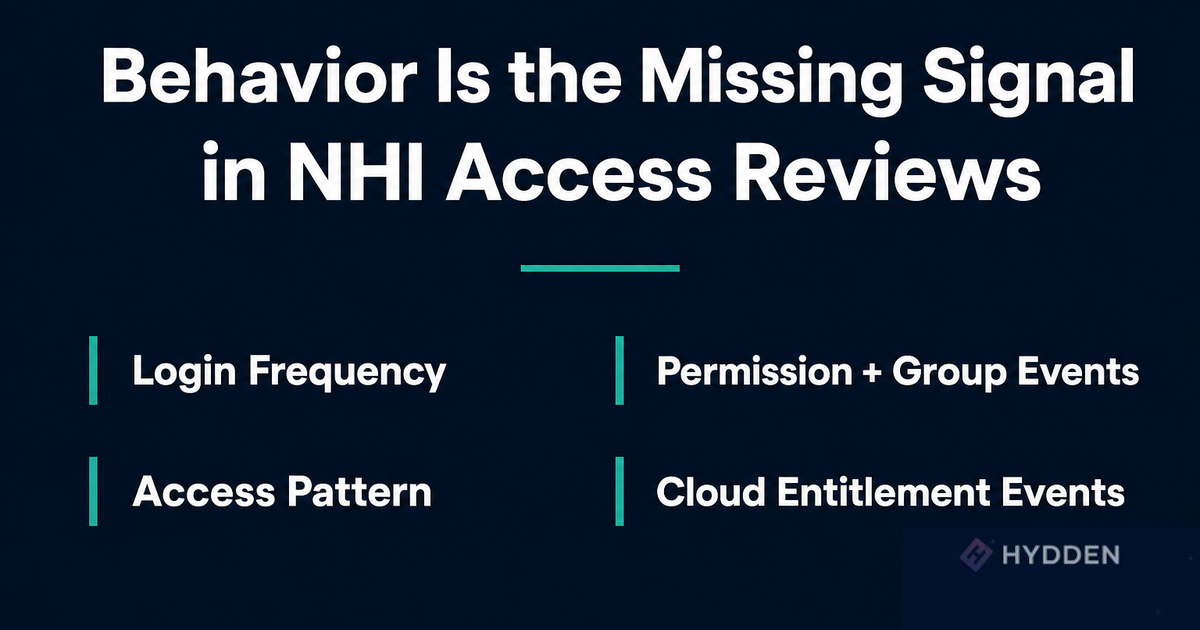
Hydden’s data mesh continuously observes what happens across every enterprise system: login frequency, access pattern type (human interactive, programmatic, service-to-service, AI agent), entitlement change events, and cloud access activity. These signals do two things simultaneously.
First, they close the classification gap. An account's access pattern resolves ambiguities that stateful data leaves open. An account that authenticates programmatically via API with a stable entitlement history looks different from one that authenticated using certificate based access once six months ago and has not been touched since. Login frequency differentiates active from dormant across the full privilege tier spectrum. Permission and group events surface entitlement accumulation that would not appear in a structural snapshot.
Second, they make that classification continuous. An account's behavioral profile changes over time. For example, a service account that was stable historically picks up a new group membership. The behavioral layer catches those changes as they occur, not at the next review cycle boundary.
The Access Review Implication
Access reviews for NHI accounts get rubber stamped most often because reviewers lack enough information to make the right decision. Behavioral classification changes what a reviewer receives. Instead of a raw account with stateful attributes, the review arrives pre-populated: how it has been accessing resources, whether its entitlement profile changed since the last review cycle, and how active it has been. For accounts where the classification is clear and behavior is consistent with policy, the review can be automated entirely. For accounts where behavior is anomalous or classification is ambiguous, human judgment is applied where it is actually needed.
That shift from uniform manual review to classification-driven automation with targeted human escalation is where access review programs recover meaningful throughput.
Continuous Discovery as the Entry Point
Hydden’s behavioral data adds the necessary context on top of our complete, continuous discovery data. Classifying accounts based on their activity makes it possible to confidently automate accounts to vaults, transitions to ephemeral, or takes route to the correct human to loop into the approval process.
The goal is a closed loop: discovery surfaces accounts as they appear, behavioral signals classify them in real time, and the access review system receives pre-classified findings with enough context to route them correctly. Coverage gaps in discovery produce gaps in classification, which produce gaps in the review program.
Hydden has already solved the discovery problem. The behavioral classification data makes a more complete discovery investment pay off faster.