
Most identity programs run into the same limit, and it shows up well before anyone reaches a certification campaign.
A large enterprise runs thousands of applications, and a governance program typically covers only a fraction of them. The rest sits outside the program entirely: legacy platforms, custom internal tools, niche SaaS, the database with local accounts nobody remembers provisioning. That is exactly where dormant, over-privileged, and forgotten access accumulates. You cannot review access on a system you never connected.
So the constraint on governance is coverage. And coverage fails in two ways: the systems you never connect, and the systems you connect once and quietly lose. Few platforms address either one.
The catalogue is the first wall
Traditional identity platforms ship a fixed list of pre-built connectors. If your system is on the list, you are fine. If it isn't, you wait: for a vendor release, a professional-services engagement, a custom integration that takes weeks and sometimes never arrives. The long tail the catalogue leaves behind is the same long tail where risky access tends to hide. A catalogue leaves blind spots wherever the list ends.
"Do you integrate with our systems?" gets answered with a lookup, and for the systems that matter most the honest answer is often no, not yet.
Onboarding becomes a capability
The Hydden Universal Collector removes that wall. Instead of one rigid connector per application, it provides a single collection engine you can configure to talk to a new system on the same day, whether that system is cloud, SaaS, a directory, a database, a file feed, or a command-line interface. If a system holds identities, the collector can reach it.
You describe the system in plain language. A built-in assistant configures the integration, proposes how each source field maps to a standard identity model, and explains its reasoning so the mapping is fast to review and easy to trust. No specialist scripting. No multi-week dependency on scarce expertise. Accounts, entitlements, groups, and roles from a mainframe, a SaaS app, and a corporate directory all land in one normalized identity graph, ready for cross-system reviews and risk detection.
The second wall: connections rot
Connecting a system once is the part everyone plans for. Keeping it connected is where coverage quietly erodes, and the catalogue model rarely accounts for it.
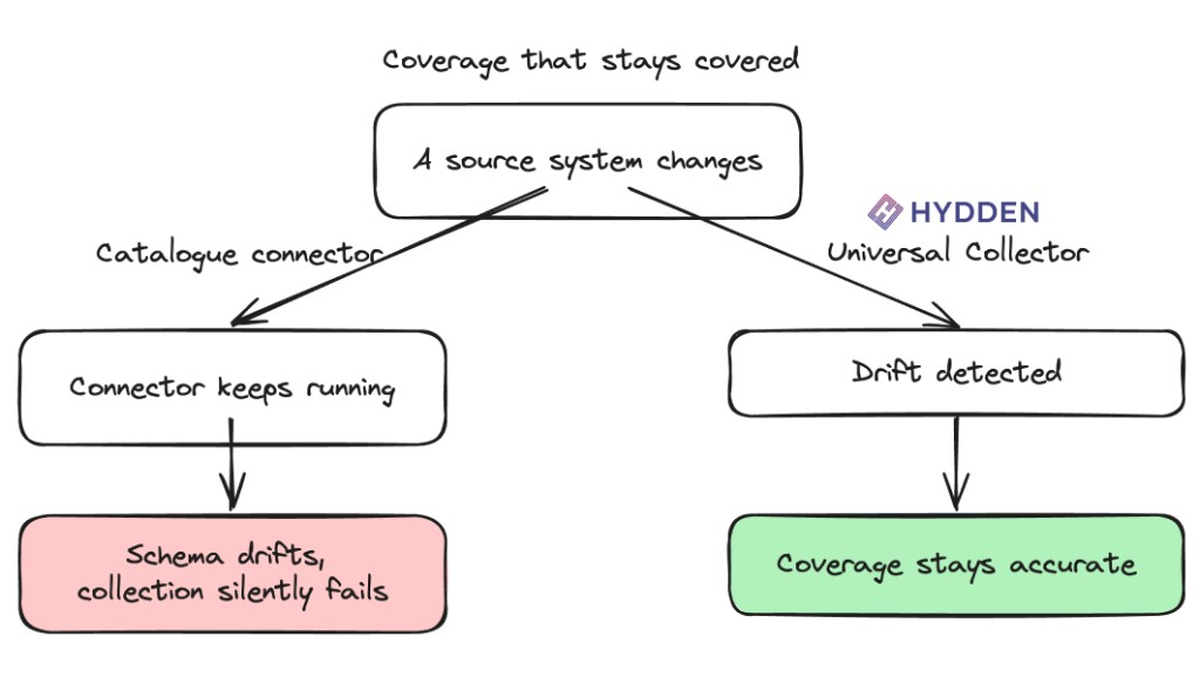
Source systems change. A vendor renames a field, deprecates an API version, restructures how entitlements are expressed, adds a new role type. A rigid connector handles that change in one of two ways. It breaks and stops collecting, or it keeps collecting and quietly returns data that is incomplete or wrong. Either way, nobody notices until an audit fails. The system still shows as "covered." The data underneath it has drifted from reality.
This is the silent failure mode of the connector catalogue. Coverage looks stable on a dashboard while it decays underneath, and decisions get made on an identity graph that no longer matches the source systems feeding it.
The Universal Collector keeps watching a connected system after onboarding day. When a source changes shape, such as a broken schema or a response the model does not expect, the platform detects it and surfaces it so the integration can be repaired before the data becomes untrustworthy. Coverage stays accurate over time, not only on the day you onboarded it.
Speed without the risk
Connecting systems quickly only helps if it does not put production at risk.
Every integration, new or repaired, is proven against the real system before it goes live, in a protected mode that cannot alter production data. You see exactly what would be collected, then commit. Proposed mappings are transparent and reviewable. Configurations are versioned and logged. Credentials are handled through a secure vault. The assistant accelerates the work; humans stay in command of it.
For regulated and segmented environments, the collector supports on-premises and privacy-conscious deployment, and reaches restricted networks out of the box. The hardest environments to govern are usually the ones that most need it.
Why it changes the economics
When integrations are configuration instead of vendor code, you are free to cover whatever you need to cover. Your teams and partners can build, extend, and adapt connections as new systems appear and existing ones change, without waiting on a vendor release. And because the platform keeps those connections healthy as the underlying systems evolve, coverage compounds into an asset that grows rather than a backlog that quietly erodes.
The result is a more complete identity picture that stays complete, built faster and cheaper, and still accurate long after onboarding day.
For most programs the open question was never which review tool to buy next. It was why half the environment stayed invisible, and why the visible half could not be trusted. Coverage you can establish and keep is the precondition for governance.
See the Universal Collector connect to a system in your environment. Book a demo at hydden.com.