
Within PAM and IGA solutions, a standard discovery scan can prove an account exists and tell you a little about its privileges. But one of the biggest gaps you're left with is attributing ownership to non-human accounts.
Most privileged access programs stall at this point, right after a discovery job completes. The scan runs, the list of privileged accounts comes back, and onboarding slows within days, because the next question isn't a technical one. It's who owns this account, and whether they know enough about it to decide how your PAM program should manage it. A standard scan has no way of answering that.
This isn't the kind of analysis discovery scans were built to do. Historically there wasn't enough information in any one place to determine the owner, so it took an actual human interaction to extract. Finding the account was the easy part, but that handoff to get answers out of people is where months go missing and expensive consultants get brought in.
Attribution is the real gate on onboarding
Nobody vaults or rotates a credential without knowing what depends on it, because breaking an unknown dependency in production is not an outage anyone volunteers for. So the account stays exactly where it is, through this cycle and the next one. An unattributed account survives every review it appears in.
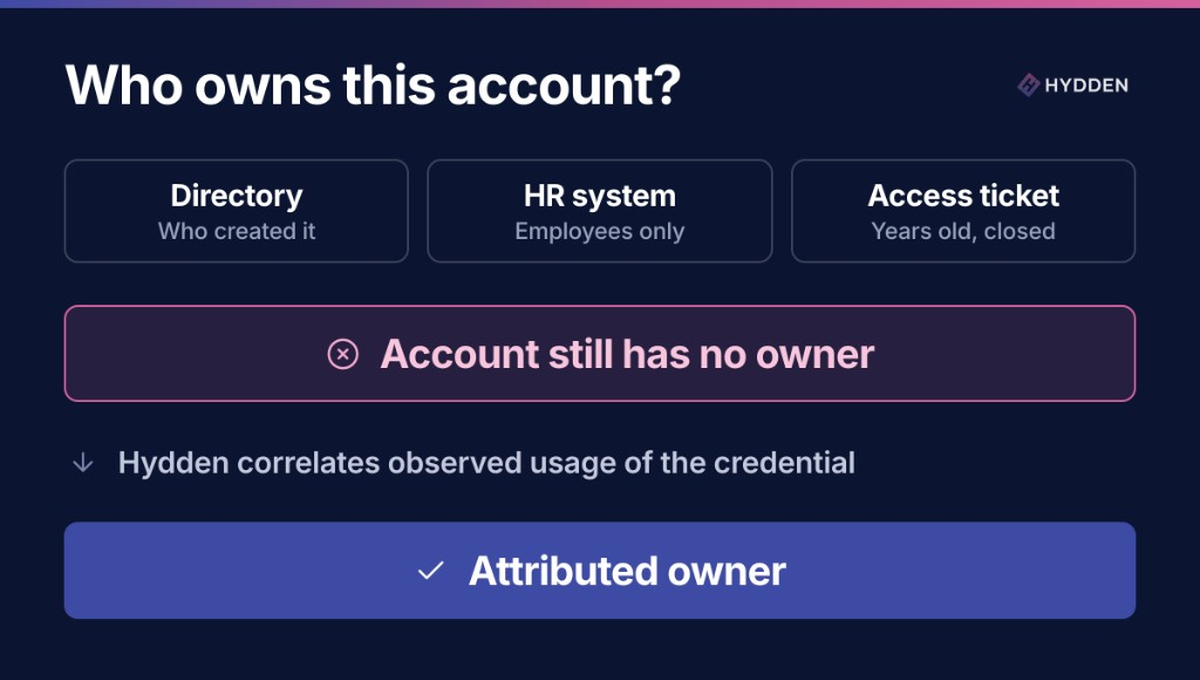
No single field in any system you call a "source of truth" holds the answer either. The directory records who created the account and often nothing since, HR knows employees rather than accounts, and the request ticket may be years old and closed by someone who has left. For most teams, owner attribution is a correlation problem, not something you can just look up in an existing field or property.
The gap underneath the gap
The problem is that identity has never had a continuous system of record. Every tool you own knows the current state of its own domain, and almost none of them keep the history of how that state got there. Correlating across systems, and across time, is the part nobody has owned.
Which is also why this shows up in more places than onboarding. Privileged blind spots, IGA data that drifts out of date, vaulting decisions that were right once and aren't anymore. The same rules no longer apply in today's environments, where privileged non-human identities are being rapidly created by regular, non-IT users across your organization.
Usage is the part a standard discovery scan can't supply
Hydden resolves ownership by correlating the directory, the HR record, and the observed usage of the credential itself. Usage is what settles arguments, because an account authenticating from a single host on a fixed nightly schedule has a far shorter list of candidate owners than an account nobody can place. And once you can point at the evidence, somebody can attest to the owner and hand that attestation to the auditors verifying your compliance mandates.
It's worth saying that attribution doesn't stay true on its own. Owners change roles, hosts get decommissioned, service accounts get reused for something nobody wrote down. An owner assigned at onboarding and never looked at again is the same problem a year later, which is why the correlation has to be continuous rather than a one-time pass.
Discovery is where the analysis begins
Hydden doesn't replace your PAM or your IGA. It makes them accurate. It's the Identity System of Record sitting underneath the tools you already own, keeping the privileged estate continuously known and keeping the identity data your governance stack depends on complete over time.
If your PAM discovery produces a file and any analysis then happens by hand in a spreadsheet, see what Hydden can automate for you. Assigning owners to accounts is just one mechanism to help your organization automate an account's lifecycle. In our next blog, we'll dive into how Hydden helps determine what should and should not be vaulted, and how the account stays managed correctly after that.
Frequently asked questions
Why can't a PAM discovery scan tell you who owns a privileged account?
A discovery scan reports the current state of an account: that it exists, where it lives, and roughly what privileges it holds. Ownership is not a property stored on the account in most environments, especially for non-human identities, so there is no field for the scan to read. It has to be inferred by correlating several systems along with the account's actual usage.
Why does missing ownership stall PAM onboarding?
Nobody vaults or rotates a credential without knowing what depends on it, because breaking an unknown dependency in production is not an outage anyone volunteers for. Without an owner who can confirm what the account does, the safe choice is always to leave it alone. That is how an unattributed account survives every review it appears in.
Can't you look up the account owner in the directory or the HR system?
No single source holds it. The directory records who created the account and often nothing after that, HR tracks employees rather than accounts, and the original request ticket may be years old and closed by someone who has since left. Owner attribution is a correlation problem across those systems rather than a lookup in any one of them.
How does Hydden determine the owner of a non-human account?
Hydden correlates the directory record, the HR record, and the observed usage of the credential itself. Usage is what settles arguments, because an account authenticating from a single host on a fixed nightly schedule has a far shorter list of candidate owners than an account nobody can place. Once the evidence is visible, somebody can attest to the owner and that attestation can be handed to auditors.
Does account ownership stay accurate after it is assigned?
Not on its own. Owners change roles, hosts get decommissioned, and service accounts get reused for things nobody wrote down, so an owner assigned at onboarding and never revisited is the same problem a year later. The correlation has to run continuously rather than as a one-time pass during onboarding.
Does Hydden replace PAM or IGA?
No. Hydden is the Identity System of Record underneath the tools you already own, keeping the privileged estate continuously known and the identity data your governance stack depends on complete over time. It makes the PAM and IGA investments you have already made accurate.