
For most security teams, the work of understanding an identity begins as an alert: an account did something, from somewhere, and somebody has to decide whether it matters. That habit makes sense for people. It works less well for AI agents and other non-human identities, because a lot of their risk shows up before use or behavior ever becomes the question.
That risk starts on the day the account behind an AI agent is granted access, and it grows each time that access changes. A permission gets added to fix a problem. The person who set the agent up moves on. Detection that waits for use or behavior can miss months of those changes. We call the stretch between the grant and the first alert "the grant gap." Here's what it looks like in practice.
An AI agent gets access in April. The alert shows up in October.
In April a team sets up an AI agent to run overnight jobs that read from two data stores. The agent runs under a service principal created for it, with a role that grants read access. The team turns the schedule on and moves to the next task.
In July one of the jobs starts failing. An engineer adds write access on one of the data stores to get it running again. The fix works, and the extra permission stays.
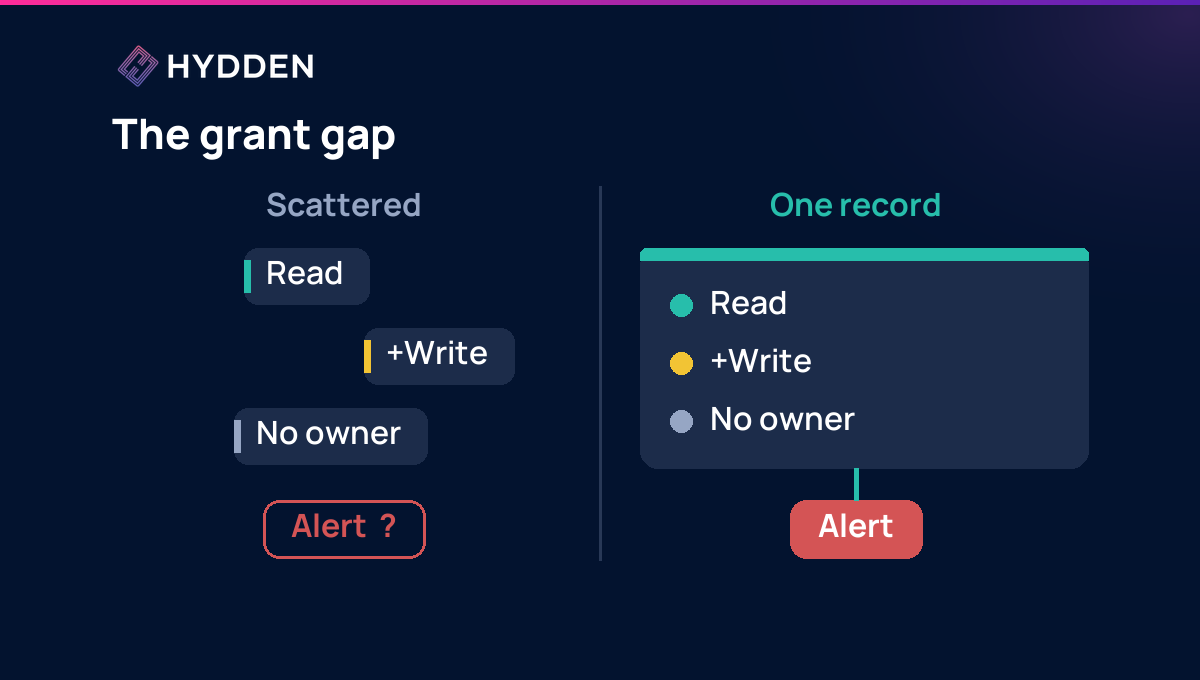
In August the person who set up the agent moves to another team. Nobody takes over the account. The agent keeps running with read access to two data stores, write access to one, and no owner.
In October a behavioral alert names the account. The analyst now has to work out what this account is, what it can reach, who approved that reach, and who owns it. Each of those changes was logged somewhere, in a cloud console, a ticket, or an HR system. None of them sit on one record the analyst can search.
Why AI agents sit in the grant gap
Identity programs grant and certify people and applications on a human calendar. A quarterly review might show the agent's service principal and its role, with little to say it belongs to an AI agent, why write access was added in July, or that its owner left in August.
SOC teams watch AI agent and other non-human activity with playbooks and behavioral analysis: unusual patterns, odd reach, jobs that deviate from a baseline. That analysis keys on use, and most of it was built around how people behave, such as sign-ins, sessions, devices, and travel. An AI agent running scheduled jobs can hold broad access for months without doing anything that stands out. Behavioral analysis can tell you when use looks wrong. It does not tell you when the access was granted, how it changed, or who owns the account behind the agent. That is detection without the record behind it.
What the current stack fails to record
Identity tools mostly hold current state. They reconcile on a schedule and overwrite what they knew last time. That tells you what is true today. It does a poor job of telling you when the AI agent's account was created, when write access was added and by whom, or when its owner left.
Changes like these are logged unevenly, each in the system where it happened, and never as one record across systems. So when the October alert fires, the analyst has to pull the story together by hand from the cloud console, the directory, and the ticket queue. That manual stitching can take days. An analyst cannot give every investigation that much time, or the queue piles up.
What Hydden records from the day of the grant
Hydden is an identity system of record. It collects from the systems you connect, including ones that never kept a useful change log of their own, and keeps a continuous history of every identity. When a collection differs from the last one, that difference becomes a timestamped event: a credential created, a role attached, an entitlement added. Where the source recorded who made the change, that travels too.An AI agent does not show up in identity systems as a freestanding actor. It runs under an account. That account might be a dedicated service principal created for the agent, a shared service account used by more than one workload, or a human user's account through user delegation. In every case there is an account behind the AI agent, and that account is what holds the privilege. Hydden links the AI agent to that underlying account. On one record you can see the agent, the account it uses, whether a human owner is mapped, what that account can reach, and how that reach changed over time.
Those events can land in the SOC platform the team runs. When the October alert fires, the analyst can query the account's history inside the case: the April grant, the July write access and who added it, and the fact that no owner is mapped today. The identity team works from the same record, for questions like which AI agents gained access last quarter and which have no owner. Enforcement still runs through the systems of authority the company owns. Hydden holds the record.
With that record in place, the October investigation starts with the account's history in front of the analyst instead of a days-long reconstruction. The identity team also had months to question the July change or the missing owner before any alert fired.
To see AI agent grants, and every change after them, as events your SOC can query, schedule a demo.
Frequently asked questions
Is the grant gap the same as shadow IT?
No. Shadow IT is systems nobody knew you had. The grant gap is access in systems you own, including the accounts behind AI agents, where each change was logged in its own place and nobody kept one history across systems.
Are SOC playbooks unprepared for AI agent activity?
No. Many SOC teams apply behavioral analysis to AI agent and other non-human activity. The grant gap is a different problem. The risk starts when access is granted and grows as it changes, while behavioral analysis keys on how the account acts after the fact.
Does Hydden model how an agent behaves over time?
No. Hydden keeps a continuous record of the grants, changes, ownership, and reach of AI agent and non-human identities. Models of how an agent acts over time are a different problem.
Where does Hydden sit relative to the SOC?
Underneath the SOC platform, not beside it. Detection and cases stay where they are. Hydden supplies the identity history those detections need when the question is what changed, who owns the account, and what it can reach.